

Looking for a new card game that’s incredibly easy to learn but surprisingly fun to play? If you’re tired of the same old rotation, it’s time you learned the Stop the Bus card game. This fast-paced affair is perfect for family night or a casual evening with friends, standing out among simple card games for groups because a single round can be played in just a few minutes. To know more, check out qqdewa
Welcome to the game where yelling “Stop the Bus!” means you’re confident your hand is good enough to win. Known in some circles as “31” or “Scat,” the goal is refreshingly straightforward: get as close as you can to a score of 31 using just three cards from a single suit. In practice, this creates a game of quick decisions and a little bit of luck, making every round exciting and unpredictable.
One of the best parts is its sheer accessibility. You don’t need any special equipment to get started, which is why it has remained a go-to choice for decades. All it takes is one standard 52-card deck and a few tokens for each player—things like coins, poker chips, or even wrapped candies work perfectly as “bus fare” to track your three lives in the game.
This guide covers the initial setup, turn-by-turn actions, and the all-important rules for scoring. You’ll have everything you need to confidently start your first round and declare that the bus is stopping.
Your First Round: How to Deal and What You Need to Play
The main goal in Stop the Bus is simple: get your hand as close as possible to a score of 31 using cards from just one suit. Instead of playing just one round, the game is about survival. Each player starts with three “lives,” often tracked with tokens like poker chips or coins. The player with the lowest score at the end of a round loses one life, and the last person with any lives left is crowned the winner.
Getting a game started is incredibly easy. All you need is:
- A standard 52-card deck
- 2 to 9 players (it’s most fun with 3 to 5)
- Three “tokens” for each player (coins, buttons, or even scraps of paper work perfectly)
To begin, choose one person to be the dealer. The dealer shuffles the deck and deals three cards face down to every player. The remaining cards are placed face-down in the center to form the draw pile. Finally, the dealer flips the top card of the draw pile face-up right next to it. This single card creates the discard pile. With your cards in hand and the two piles ready, you’re all set to play.
How to Score Your Hand: The Simple Math to Get to 31
Understanding your score is the key to winning at Stop the Bus. While the goal is to get as close to 31 as possible, there’s one crucial rule: you only add up the value of cards from a single suit. You can’t mix and match. For example, if you have two Hearts and one Spade, you calculate your Heart score and your Spade score separately, and your final score is whichever one is higher.
To figure out your score, you’ll need to know what each card is worth. The values are easy to remember:
- Aces are powerful, worth 11 points.
- Kings, Queens, and Jacks (face cards) are each worth 10 points.
- Number cards are worth their face value (a 9 is worth 9 points, a 4 is worth 4, and so on).
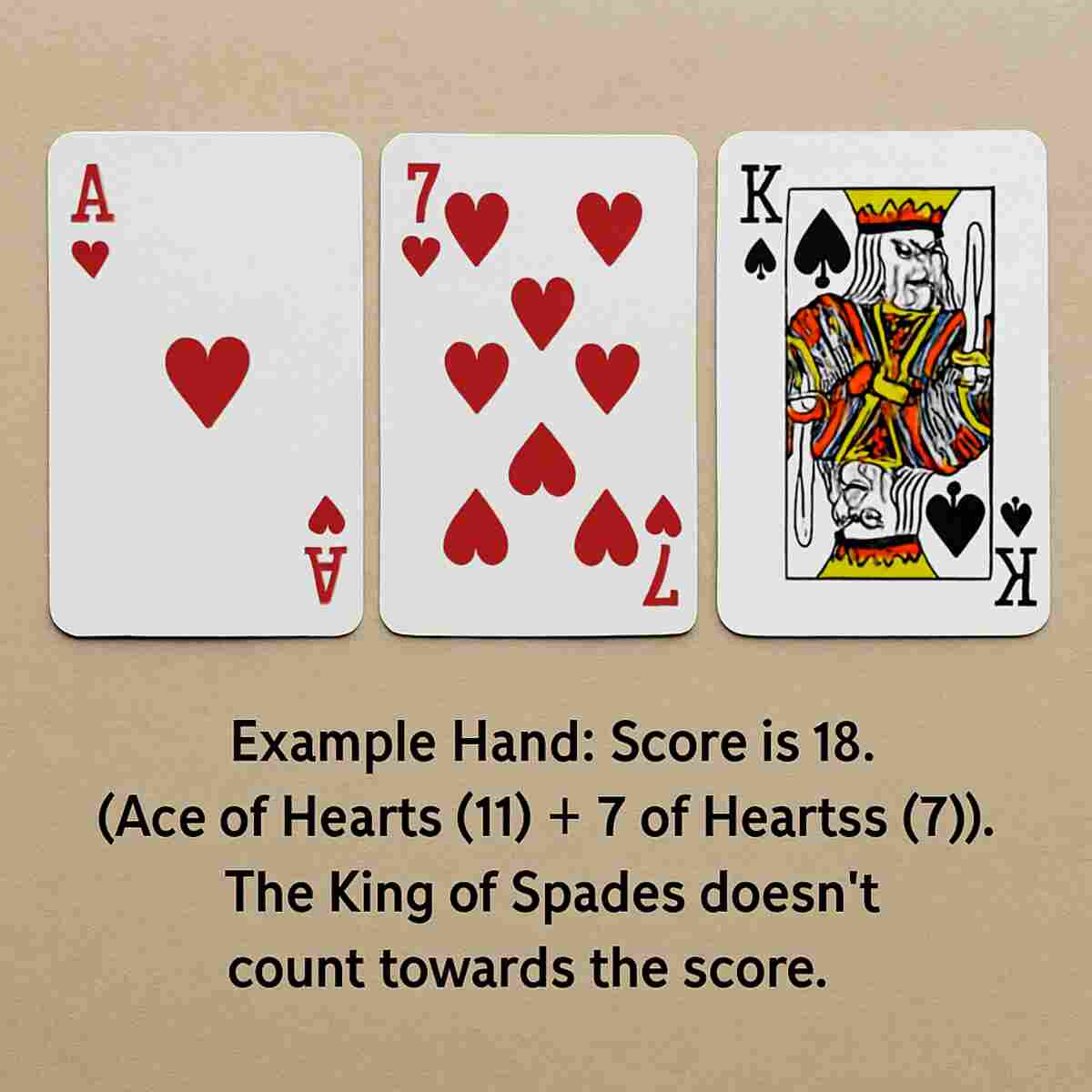
Let’s look at a sample hand. Imagine you’re holding the Ace of Hearts, the 7 of Hearts, and the King of Spades. Your Hearts add up to 18 points (11 + 7), while your single Spade is worth 10. Since 18 is higher, your score for the round is 18. The King of Spades doesn’t help your Heart total at all!
There is one special hand that breaks the rules: a “prial,” which is simply three-of-a-kind (like three 5s or three Queens). A pair is always worth a fixed score of 30.5 points. This unique score allows it to beat any hand totaling 30 or less, but it still falls short of a perfect 31.
Making Your Move: The Simple Choice That Defines Your Turn
Taking a turn in Stop the Bus is incredibly simple. Your job is to improve your hand by swapping out a card. This boils down to a single, repeating action: you will draw one new card, and then you will discard one card, always keeping your hand at three cards total.
At the start of your turn, you have two options for where to draw your card from. You can either:
- Take the top (unknown) card from the draw pile. This is a bit of a gamble, but it might be the perfect card you need.
- Take the top (face-up) card from the discard pile. You can see this card, so you know for sure if it will improve your score.
After you have drawn your new card, you’ll have four cards for a moment. To finish your turn, you must choose one card from your hand and place it face-up on the discard pile. If the card you just picked up doesn’t help you at all, you can discard it immediately! You’ll continue this cycle of drawing and discarding to inch your score closer to 31.
The Big Moment: When and How to ‘Knock’ to Force a Showdown
The game can’t go on forever, and eventually, one player will feel confident enough to end the round. This is where the most exciting move in the game comes into play: knocking. Instead of drawing a card on your turn, you can simply rap your knuckles on the table. This is your official signal to all other players that you are “stopping the bus” and are ready to compare hands.
Deciding when to knock is the core strategy of Stop the Bus. You don’t need a perfect hand of 31; you just need to be reasonably sure your score isn’t the worst one at the table. A score in the mid-to-high 20s is often a good time to consider it. Be careful, though! Once you knock, your hand is locked in for the rest of the round. You cannot change your cards, even if a perfect one lands on the discard pile right after your turn.
Your knock immediately puts the pressure on everyone else. Following your knock, each remaining player gets exactly one more turn to improve their hand. They’ll take their final draw and make their last discard in a desperate attempt to boost their score. After that last player has made their move, the time for swapping cards is over, and the showdown to find the round’s loser begins.
After the Knock: How Hands are Revealed to Find the Loser
The knock sets off a final, frantic scramble around the table. Following the knock, every other player gets exactly one more turn to improve their hand. This is their last chance to swap a card, so they’ll be watching the discard pile closely or hoping for a lucky draw from the deck. Remember, the player who knocked is locked in; their turn is over, and they cannot change their cards.
When the final player has made their last move, the round officially ends. It’s time for the showdown. Starting with the player to the dealer’s left, everyone lays their three cards face-up on the table for all to see. This is the moment where everyone compares their final hands and calculates their scores based on their single best suit.
With all the cards revealed, it’s easy to see who came out on top—and more importantly, who didn’t. Unlike many games where you’re looking for the highest score, in Stop the Bus, you’re trying to avoid having the lowest score. The player whose hand has the lowest point total loses the round. This can even be the player who knocked if they were too bold, and someone else improved their hand on that final turn!
The player with the lowest score must pay the price by turning in one of their three starting tokens. What happens if there’s a tie for the lowest score? In that unfortunate scenario, every player involved in the tie loses a token.
Three Simple Strategies to Boost Your Winning Chances
While Stop the Bus involves a healthy dose of luck, you can tilt the odds in your favor with smart play. Just paying attention can make all the difference in holding onto your tokens longer and putting pressure on your opponents when they least expect it.
One of the best strategies is to simply watch what other players discard. If you see someone throw away the King of Diamonds, it’s a safe bet they aren’t collecting Diamonds. This gives you two advantages: you know that player won’t be competing with you for that suit, and you have a better idea of what cards might be “safe” to pass through the discard pile later on without helping someone else.
Knowing when to knock is another powerful tool. Many new players wait until they have a very high score (like 28 or more), but sometimes the best move is to knock with a “good enough” hand, such as 23 or 24. If you notice that players are frequently swapping cards and seem to be struggling, knocking early can force them into a final, difficult turn. This aggressive move can often secure you a win by catching others before their hands are ready.
Finally, think about how you evaluate your hand early in the game. It can be tempting to immediately get rid of any card that doesn’t match your highest suit. However, holding onto a single high-value card (like an Ace or a King) from a different suit can be a smart play. It keeps your options open. If you suddenly draw another high card of that new suit, you can pivot your strategy instantly and stay flexible.
Playing Your Way: Fun Variations for Any Group
One of the best things about Stop the Bus is its flexibility. If you’re wondering if you can play with just two players, the answer is yes—with one small, crucial tweak. After a player knocks, the other player gets their final turn as usual, but then the knocker also gets one last chance to draw and discard. This prevents the first player to knock from having an unfair advantage and turns the endgame into a tense, tactical decision.
For a more strategic twist that works for any group, try one of the most popular game variations: playing with “The Kitty.” Instead of a single discard, deal three cards face-up in the middle of the table. On your turn, you can either take one of these three known cards or draw a mystery card from the deck. Your discard then replaces the card you took from the Kitty, keeping three options available. This version opens up more choices each turn and rewards players who pay close attention.
If these rules sound vaguely familiar, you might have already encountered games similar to Stop the Bus. The game is known worldwide by other names, most commonly “31” or “Scat.” While the core goal of collecting cards in a single suit remains the same, different house rules often pop up under these names—for example, some versions give a special high score for having three-of-a-kind. Knowing these alternate titles can help you jump into a game, even if you don’t recognize the name they’re using.
Ultimately, the best way to play is whatever your group enjoys most. Whether you’re adapting for a duel, adding the strategic Kitty, or calling it 31, the core of the game remains accessible and entertaining.
Time to Play
You now have all the rules needed to deal the cards, guide your friends, and crown a winner. The best way to cement your knowledge is to simply grab a deck and play a round. Don’t worry about mastering strategy right away; focus on the simple rhythm of drawing, discarding, and deciding when to knock. You’ll quickly see that the game is less about the numbers and more about the shared moments—the suspense of the final turn, the luck of a good draw, and the fun of declaring the round is over.
