



You think of a character—any character, from a forgotten cartoon hero to a famous historical figure. Now, what if a simple website could guess that exact character by asking just a handful of yes-or-no questions? This is the uncanny experience of the twenty questions online game, a trick that has left millions of players wondering if the computer can read their minds. What do you need to consider about valid77.
While it feels like magic, the answer is surprisingly straightforward. The computer isn’t psychic; it’s just following a very clever, yet simple, process. The secret behind how an AI that plays 20 questions works is less about being “smart” and more about being incredibly organized. The “magic” is actually a brilliant process of elimination that uses your answers to narrow down millions of possibilities.
First, A Quick Refresher on the Classic 20 Questions Game Rules
To understand the AI, it helps to review the classic parlor game. The premise is wonderfully simple: one person thinks of something, and everyone else tries to figure out what it is. The formal rules for how to play 20 questions are straightforward:
- One person (the “thinker”) secretly chooses an object, person, or place.
- The others (the “guessers”) can ask up to 20 yes-or-no questions.
- The goal is to guess the secret before you run out of questions.
The real strategy, however, isn’t about random guessing; it’s about asking the right questions. This is a game of deductive reasoning, where each answer eliminates huge categories of possibilities. For instance, if you ask, “Is it alive?” and the answer is “no,” you’ve just thrown out every person, animal, and plant in existence. A good player uses each question to slice the world of possibilities in half. Humans do this with intuition and life experience, but how does a computer learn to be such a clever questioner?
The AI’s ‘Brain’: A Giant Encyclopedia of Everything
So, how does a computer become such a clever questioner without human intuition? The answer is surprisingly simple: it doesn’t think, it cheats. The AI that plays 20 questions has access to a massive digital “brain,” which is less like a thinking mind and more like a gigantic, hyper-organized encyclopedia of everything you could imagine. This isn’t a machine that understands “Darth Vader”; it’s a program that has a file folder labeled “Darth Vader” full of information.
For every single character, object, or concept in its memory, the program stores a list of pre-answered questions. Think of an entry for “an elephant.” The encyclopedia page for it would already have answers logged: Is it an animal? Yes. Is it bigger than a microwave? Yes. Does it live in the ocean? No. The same goes for Taylor Swift, the Eiffel Tower, or your favorite cartoon character. Each one is just an entry with a checklist of yes/no properties attached.
The secret behind how 20 questions online works, then, isn’t some mysterious intelligence. It’s the sheer scale and organization of this data. The online 20 questions guesser’s power comes from having instant access to hundreds of thousands of these detailed “pages.” But having all that information is one thing; knowing how to use it is another. The real trick is how the AI uses your answers to instantly search this enormous encyclopedia and narrow down the possibilities.
How a Single ‘Yes’ or ‘No’ Can Eliminate Millions of Answers
With that giant encyclopedia in its memory, the AI’s next job is to search it efficiently. It doesn’t flip through pages at random; it employs a powerful strategy you already use in everyday life: the process of elimination. The computer’s goal with every single question is not just to learn something new, but to discard the largest possible number of wrong answers in one fell swoop. This is the core of all deductive reasoning games online.
The most powerful questions are the ones that split the remaining possibilities right down the middle. For instance, a first question like “Is your character a real person?” is brilliant. If you say “yes,” the game can instantly ignore every fictional character in its database—from Homer Simpson to Harry Potter. With one click, half of its job is done. A follow-up like “Is your character still alive?” performs another massive cut. It’s like taking a giant pair of scissors to that encyclopedia, slicing away entire sections that are no longer relevant based on your answer.
This continues with every question. Each “yes” or “no” you provide guides the program down a path, narrowing the field from hundreds of thousands of options to just a few dozen, and finally, to one. It isn’t thinking; it’s surgically removing everything your character is not until only one possibility remains. But what happens when this process fails and it guesses incorrectly? That moment of failure is actually the secret to how it gets even smarter over time.
What Happens When You Stump the AI? (This Is Its Secret to Getting Smarter)
Inevitably, you’ll think of something so unique that the game’s final guess is wrong. You’ve won! But this isn’t a failure for the AI; it’s an opportunity. Instead of just giving up, the program will admit it’s been stumped and ask you what you were thinking of. This is the moment where the game goes from being a clever opponent to a diligent student, and it’s the absolute key to its ever-expanding “brain.”
When you reveal your answer, the game doesn’t just add the name to its list. It will also ask you to provide a new yes/no question that would have helped it tell the difference between its wrong guess and your correct one. For example, if it guessed “Darth Vader” but you were thinking of “Luke Skywalker,” it might prompt you for a question. You could add, “Is your character the main hero of the original trilogy?” The AI then permanently saves “Luke Skywalker” along with the fact that the answer to that new question is “yes.”
Now, imagine this exact process happening thousands of times every day, with players all across the globe. Each time someone stumps the game and teaches it a new character and a distinguishing question, its virtual encyclopedia grows smarter and more detailed. The game’s incredible, seemingly psychic knowledge doesn’t come from a single programmer, but from the collective corrections of millions of players like you. This collaborative learning has created different games with unique databases, so which online guesser is the best one to challenge first?
Akinator vs. 20Q.net: Which Online Guesser Should You Play First?
Now that you know how these games get so smart, where should you go to test their powers? The two biggest names in the online twenty questions world are Akinator and 20Q.net. While they both use the same core logic of asking questions to narrow down possibilities, they have evolved to have very different personalities and specialties. Choosing between them is less about which one is “smarter” and more about what you want it to guess.
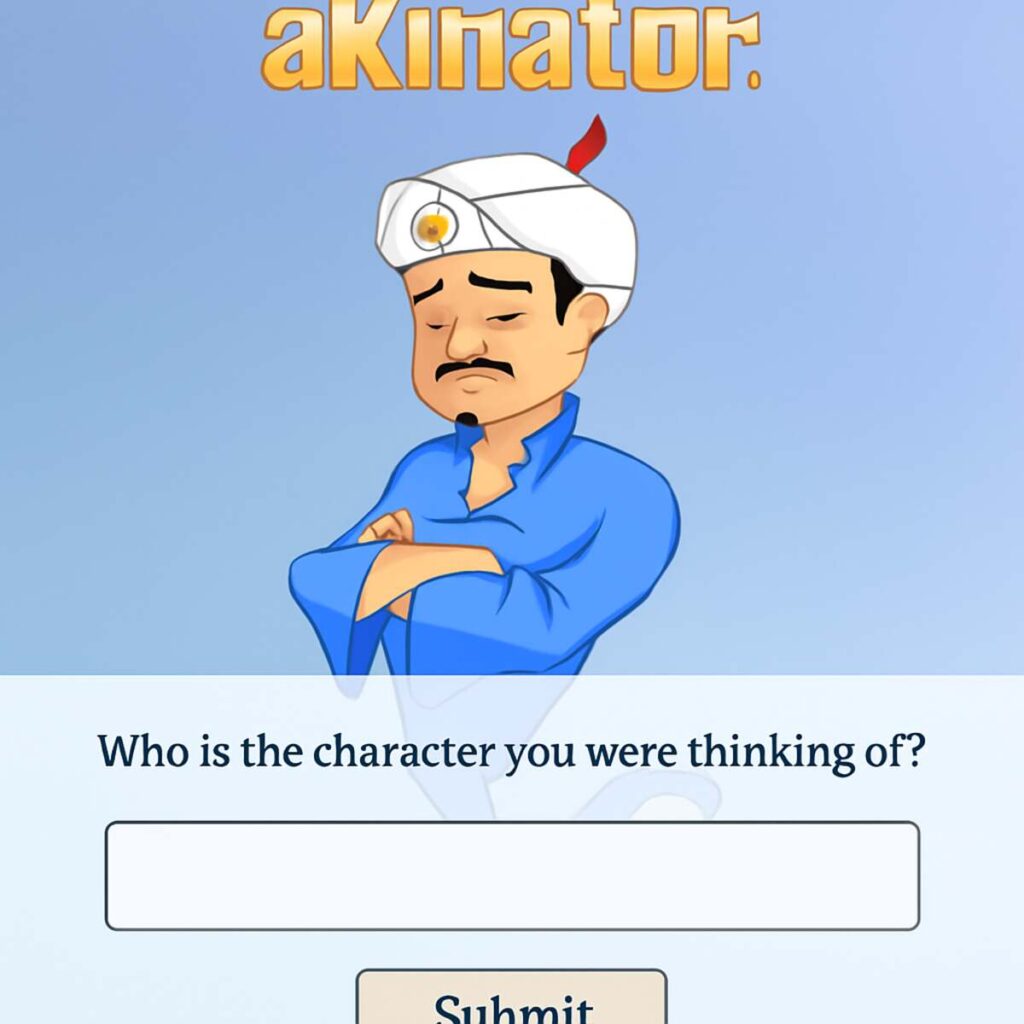
The most famous platform is undoubtedly Akinator, the “Web Genie.” This game is all about characters. Thanks to its massive, player-built database, it has become an unrivaled expert at guessing people and fictional beings. If you’re thinking of a celebrity like Taylor Swift, a video game hero like Mario, or a cartoon character like SpongeBob, Akinator is the place to go. Its slick, modern interface and popular mobile app make it feel more like a dazzling magic show.
For a different kind of challenge that feels closer to the original parlor game, try 20Q.net. This site is the direct online version of the classic handheld electronic toy from the 1990s. Its strength isn’t in pop culture figures but in general objects and concepts. Can it guess “a banana,” “a dog,” or even something as abstract as “love”? This is where 20Q shines. So the verdict is simple: start with Akinator if you’re thinking of a character, and head to 20Q to see if you can stump it with an everyday object.
Ready to Play? Here’s Where to Go
Feeling ready to challenge the AI yourself? The best part is you can jump right into the action from your computer or phone. Many of these games are available directly in your web browser, so you can play 20 questions without downloading a single file. For those who prefer playing against a human opponent, there are also simple apps designed for two players.
Here are the best places to start your guessing game adventure:
- Akinator (Web & Mobile): The famous character-guessing genie. It’s perfect for testing its uncanny knowledge of pop-culture figures, and you can play on their website or through the popular mobile app.
- 20Q.net (Web): The classic online AI that guesses animals, minerals, and everyday objects. If you want the original “is it bigger than a breadbox?” experience, this is the place to go.
- Guessing Game for Two Players (Mobile): Looking for a free multiplayer guessing game to play with a friend? Search your app store for a “20 questions app for two players.” These simple apps let one person think of a word while the other uses the phone to ask questions and track their progress.
How to Host Your Own Virtual Twenty Questions Game on Zoom
Those AI guessers are incredibly fun, but sometimes you want the classic experience of trying to outsmart a real person. Hosting virtual twenty questions for Zoom or any video call app is surprisingly easy and makes for a fantastic, free activity for online game nights. To start, simply gather your friends on a call and designate one person as the “thinker” for the first round. To prevent any accidental peeking or revealing facial expressions, have the thinker privately message their secret person, place, or thing to a designated “host” before the questioning begins.
The biggest challenge when you play 20 questions with friends online is keeping track of the question count. A simple solution is to use the chat window as your public scoreboard. As the group takes turns asking their yes-or-no questions out loud, the host or another volunteer can type the question number (“1,” “2,” “3,” etc.) into the chat after each one is asked. This keeps everyone on the same page and lets the group know exactly how many chances they have left.
From there, the rules are just like the classic game. The thinker can only respond with “Yes” or “No” as the group works together to narrow down the possibilities. If the group correctly guesses the answer before hitting the 20-question limit, they win the round! If not, the thinker reveals the answer and claims victory. It’s one of the most engaging online guessing games for groups because it requires teamwork and a bit of clever detective work. The real secret to winning, of course, lies in the kinds of questions you ask.
How to Be a Better Player: Tips for Asking Great Questions
Whether you’re trying to stump your friends or an AI, the secret to winning lies in your questions. The biggest mistake players make is asking something too specific, too soon. A question like, “Is it the Eiffel Tower?” on your first turn is a gamble. If the answer is “No,” you’ve only eliminated one single thing from the entire universe of possibilities. The #1 rule for guessing is to start broad. Your first few questions should act like a giant axe, chopping the world of possible answers in half.
The most powerful trick is to ask questions where you’d be equally happy with a “yes” or a “no.” Think about it: a question like “Is it alive?” is a perfect opener. If the answer is “yes,” you can instantly ignore every object, place, and idea. If it’s “no,” you can forget about every person, animal, and plant. Either way, you’ve made huge progress. This strategy is at the heart of all deductive reasoning games online, where the goal is to eliminate possibilities as efficiently as you can. The game’s strict “yes/no” format, a key part of the 20 questions game rules explained everywhere, forces this clever thinking.
To get you started, here are a few all-purpose opening questions that can give you a massive head start. Thinking about what are good questions to ask in 20 questions is the first step to becoming a master guesser.
- Is it bigger than a microwave? (Establishes scale)
- Is it alive? (Separates living from non-living)
- Is it a fictional person or thing? (Splits reality from imagination)
- Was it invented in the last 100 years? (Determines a time period)
How to Be a Better Player: Tips for Picking Tricky Objects
Flipping the script from guesser to thinker offers a new challenge: how do you pick something nearly impossible to guess? The most effective strategy isn’t to choose something incredibly obscure, but to select an idea that blurs the lines. The goal is to force your opponent into a “Maybe?” or “I don’t know” answer, which throws a wrench into their process of elimination. Picking something with fuzzy, ambiguous properties is the ultimate defense.
This strategy is especially powerful against computer opponents. Online guessing games thrive on certainty and sorting things into neat boxes. But what if your item doesn’t fit in any box? Picking an abstract concept like “the future” or “a dream” creates chaos for the system. Is a dream “real”? Does it “exist” in a physical place? These questions don’t have simple yes-or-no answers, making it much easier to stump the AI. It’s the perfect way to test the limits of its programming.
Ready to give it a shot? If you’re looking for a 20 questions object list ideas to challenge your friends or a computer, try picking one of these mind-benders:
- The concept of ‘yesterday’
- The color ‘blue’
- A ‘shadow’
- Your ‘reflection in a mirror’
Choosing one of these will reveal just how much these games rely on clear-cut logic and might just earn you a win against a seemingly unbeatable opponent.
More Than a Game: Why This Simple AI Is a Glimpse into the Future
What once felt like a digital magic trick—a game that could somehow read your mind—is now a process you can see clearly. You’ve pulled back the curtain and found not a mysterious crystal ball, but a clever, step-by-step system of elimination. You now understand the simple logic that powers any AI that plays 20 questions, turning a massive list of possibilities into a single, stunningly accurate guess.
This core idea isn’t just for fun, either. You’re now equipped to spot this logic all over the internet. When a support website’s chatbot asks, “Is your issue about billing or technical support?” it’s doing the same thing: using a smart question to narrow down the options and get to the right answer faster. This is a perfect, simple explanation of how AI works in many everyday tools, using questions to classify your needs.
So go ahead and challenge one of these deductive reasoning games online. But this time, play it differently. As it asks you questions, try to visualize its giant encyclopedia shrinking with each “yes” or “no.” You’re no longer just a player trying to stump the machine; you’re an informed observer, watching one of the basic building blocks of artificial intelligence do its work. The magic isn’t gone—you just know how the trick is done.