


Learning the periodic table does not have to mean staring at element boxes until the names blur together. With the right mix of patterns, visual tools, memory prompts, and playful practice, students can turn a difficult-looking chart into a map that actually makes sense. This guide shares practical, engaging ways to learn the periodic table, whether you are studying for a class, helping a child build confidence, or simply trying to understand chemistry better. Obtain the Best information about slot online.
Why does the periodic table feel so hard to learn?
The periodic table feels hard because it combines unfamiliar names, symbols, numbers, categories, and patterns all at once. Many learners try to memorize it from left to right, but the table is not designed like a simple list. It is a structured system, and it becomes much easier to learn when you study it as a set of relationships instead of a wall of facts.
At first glance, the element symbols can feel random. Some are obvious, like O for oxygen, while others come from Latin or historical names, such as Na for sodium. Add atomic numbers, metals, nonmetals, noble gases, and group names, and the table can seem like a code you were never taught to read.
The good news is that the periodic table rewards curiosity. Once students notice that elements are arranged by atomic number, that columns often share chemical behavior, and that regions of the table have recognizable traits, memorization becomes less isolated. A name is no longer just a name; it belongs to a neighborhood.
That is why engaging study methods work so well. A periodic table game, a color-coded chart, a drawing challenge, or an interactive periodic table can help learners explore patterns actively. Instead of asking, “How do I remember all of this?” the better question becomes, “What does this part of the table tell me?”
Start with the big picture before memorizing details
One of the most common mistakes is trying to memorize every element immediately. That approach can create stress because there is no clear framework for where each fact belongs. A better starting point is to understand the table’s layout in broad sections.
Begin by looking at the rows and columns. The rows are called periods, and the columns are called groups. Elements in the same group often share similar characteristics, which is why the table is arranged vertically in such a meaningful way. For example, the noble gases appear together because they have related chemical behavior.
Next, notice the major regions. Metals occupy much of the left and center of the table. Nonmetals are mostly found toward the upper right. Metalloids form a kind of staircase between them. The lanthanides and actinides usually appear as two separate rows below the main table to keep the chart compact.
You do not need to master every category in one sitting. The goal is to give your brain a map. When you later learn about chlorine, calcium, carbon, or copper, you can attach that element to a location and category rather than treating it as a disconnected word.
A simple first-week learning plan might look like this:
- Learn what the atomic number represents.
- Identify the difference between periods and groups.
- Locate metals, nonmetals, and metalloids.
- Learn the names of a few major groups, such as alkali metals, alkaline earth metals, halogens, and noble gases.
- Practice finding common elements by their symbols and locations.
This foundation makes every later activity more useful. Games become more strategic, flashcards become more meaningful, and practice quizzes feel less like guessing.
Turn memorization into a periodic table game
A well-designed periodic table game can make repetition feel purposeful instead of tedious. The best games do not simply ask students to recite facts; they ask learners to match, sort, build, connect, and explain. This gives the brain more ways to store and retrieve information.
You can play these games with printed cards, a whiteboard, sticky notes, digital tools, or a classroom screen. The format matters less than the activity. The key is to keep the game short, focused, and connected to a clear learning goal.
Element symbol match
Write element names on one set of cards and symbols on another. Mix them up and ask learners to match each name with its correct symbol. Start with familiar elements like hydrogen, oxygen, carbon, iron, gold, silver, sodium, and chlorine before adding less familiar ones.
To make it more engaging, introduce rounds. In round one, students can use a reference chart. In round two, they try without help. In round three, they explain one tricky symbol and why it might not match the English name. This helps students understand that some symbols come from older names or other languages.
Periodic table bingo
Create bingo cards with element symbols, names, atomic numbers, or categories. Instead of calling out “B-12” style clues, read prompts such as “a noble gas,” “the element with symbol Fe,” or “a metal commonly associated with electrical wiring.” Students mark the correct answer if it appears on their card.
This turns recognition into an active search. Students are not passively looking at the table; they are scanning, comparing, and making decisions. It also works well for groups because learners can discuss clues and justify their choices.
Element neighborhood challenge
Choose an element and ask students to describe its neighborhood. What group is it in? What period is it in? Is it a metal, nonmetal, or metalloid? What elements are nearby? What might its location suggest about its behavior?
This game is especially helpful because it shifts attention from isolated memorization to table literacy. Students learn to “read” the chart the way they might read a map. Location becomes information.
Speed sort by category
Give learners a stack of element cards and ask them to sort the cards into categories such as metals, nonmetals, noble gases, halogens, or transition metals. For beginners, use a small set of cards and allow a reference chart. For more advanced learners, add a time limit or require students to explain one card from each category.
Sorting is powerful because it forces comparison. Students begin to notice patterns, exceptions, and recurring features. They also get physical movement if using paper cards, which can help break up long study sessions.
Mystery element clues
One player chooses an element and gives clues one at a time. Clues might include “I am in period 3,” “I am a nonmetal,” “My symbol has one letter,” or “I am important for life.” Other players guess the element as quickly as they can.
This game works because it combines reasoning with recall. Students must use the table’s structure to narrow the possibilities. It can also be adapted for different levels by making clues easier or more detailed.
Use an interactive periodic table to explore patterns
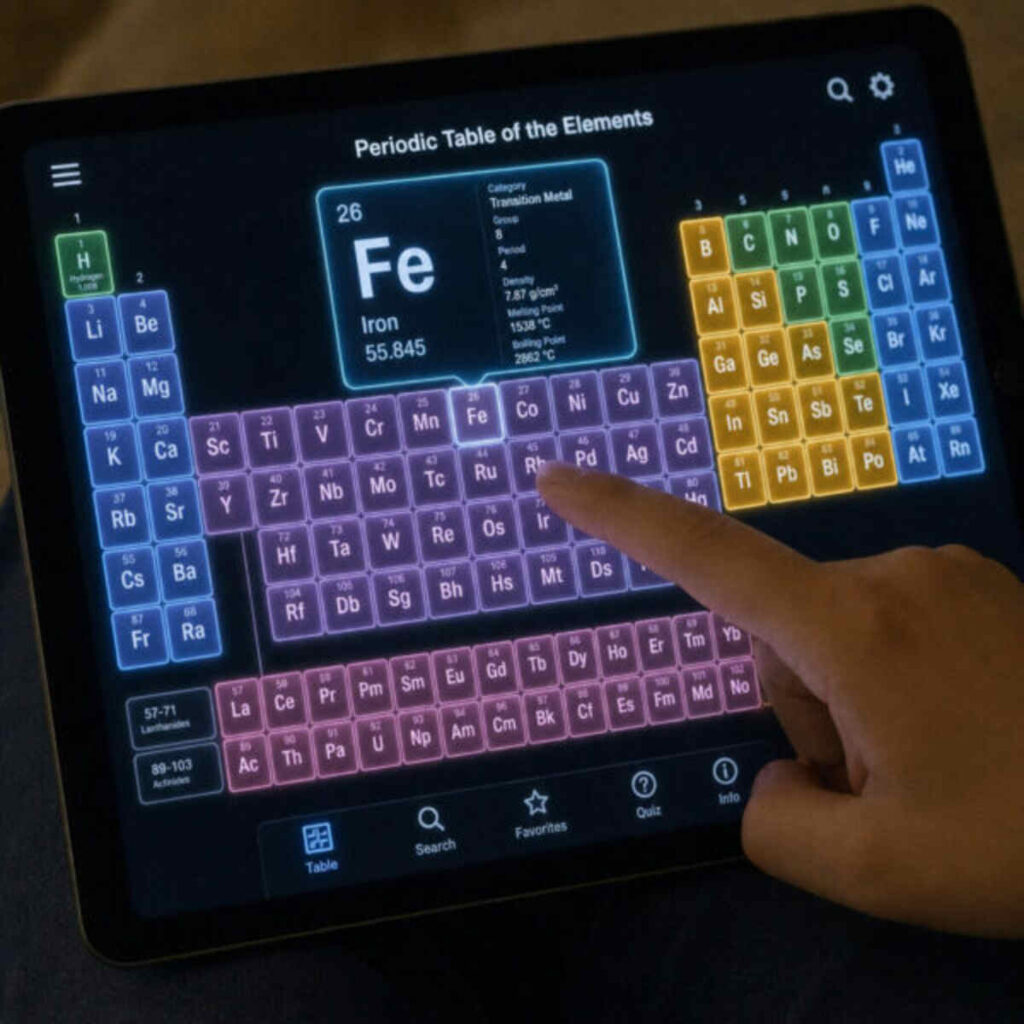
An interactive periodic table helps learners move beyond static memorization by letting them click, filter, highlight, and compare elements. This is especially useful for visual learners and students who like to explore independently. Instead of reading a long list of facts, they can investigate one pattern at a time.
A strong interactive tool can support many kinds of practice. Students might highlight all gases, compare atomic masses, explore electron configurations, or click through the uses of elements. The experience feels more like discovery than review, which can increase motivation.
When using an interactive periodic table, it helps to set a specific goal before beginning. Otherwise, the tool can become distracting. A focused prompt keeps the activity productive.
Try prompts like these:
- Find five elements named after places, scientists, or mythological figures.
- Highlight the noble gases and describe what they have in common.
- Compare three elements from the same group and note one shared pattern.
- Locate elements commonly found in the human body.
- Choose one metal, one nonmetal, and one metalloid, then explain how their locations differ.
- Find an element you have heard of in daily life and learn one new fact about it.
Interactive tools are also useful for review because they offer immediate visual feedback. If a student filters by category and sees a region light up, the pattern becomes memorable. That visual memory can later support quizzes, lab work, and class discussions.
For best results, combine digital exploration with a written task. Ask students to keep a short “element discovery log” in which they record the element’s name, symbol, location, category, and one interesting observation. This prevents clicking without thinking and gives learners a personal study resource.
Build memory with stories, associations, and mnemonics
Memorization is easier when facts connect to images, stories, sounds, or experiences. The periodic table offers plenty of opportunities for creative association because element names and symbols are distinctive. A playful memory cue can make a difficult symbol stick.
For example, students often remember He for helium by thinking of helium balloons floating “high.” They might remember Fe for iron by connecting it to “ferric” or “ferrous” in chemistry vocabulary. Sodium’s Na can be linked to its Latin-derived name, natrium, which explains why the symbol does not match the English word.
The goal is not to create a perfect historical explanation for every element. The goal is to build a retrieval hook. If a silly phrase helps a student remember that K stands for potassium, it is doing useful work.
Here are practical ways to use memory cues:
- Create a mini-story for confusing symbols, especially those that do not match their English names.
- Draw a small icon next to an element, such as a balloon for helium or a ring for gold.
- Connect elements to everyday objects, foods, technologies, or experiences.
- Use sound patterns, rhymes, or alliteration for groups of elements.
- Make “element characters” with personalities based on their properties or locations.
Memory cues work best when students create them themselves. A teacher or parent can offer examples, but a self-made association is usually more memorable. It reflects the learner’s own humor, interests, and mental shortcuts.
This approach is also helpful for students who feel intimidated by science. Creative memory work shows that chemistry is not only about formulas. It can involve language, imagination, design, and storytelling.
Learn by grouping elements instead of chasing perfection
Trying to learn the entire periodic table in one long session can be discouraging. A more practical strategy is to group elements into manageable sets. This gives learners a sense of progress and helps them focus on meaningful patterns.
Start with common elements. Hydrogen, oxygen, carbon, nitrogen, sodium, chlorine, calcium, iron, copper, gold, silver, and helium are familiar because they appear in everyday language, biology, materials, or simple chemistry lessons. Once those feel comfortable, expand to related groups.
You might organize study sessions around themes:
- Elements in daily life: oxygen, carbon, hydrogen, nitrogen, iron, aluminum, copper, silicon.
- Elements in the body: oxygen, carbon, hydrogen, nitrogen, calcium, phosphorus, potassium, sulfur.
- Elements in technology: silicon, lithium, copper, gold, silver, cobalt, nickel.
- Reactive groups: alkali metals, halogens, alkaline earth metals.
- Stable or less reactive groups: noble gases and selected transition metals.
This approach gives each element context. Learners can say, “I know carbon because it is central to living things,” or “I know silicon because it is important in electronics.” Context supports memory far better than repetition alone.
Grouping also makes review easier. Instead of asking, “Do I know the periodic table?” students can ask, “Do I know the first 20 elements?” or “Can I identify the noble gases?” Smaller questions are less overwhelming and easier to answer honestly.
A helpful rule is to study in sets of five to ten elements at a time. Review the previous set briefly before adding a new one. This keeps older material active while giving the brain time to absorb new information.
Make visual learning part of the routine
The periodic table is a visual tool, so visual learning should be part of the study plan. Color, spacing, symbols, and shapes can all help students recognize patterns faster. A plain black-and-white table may work for reference, but a visual study version can make learning more intuitive.
Color-coding is one of the simplest strategies. Assign different colors to metals, nonmetals, metalloids, halogens, noble gases, and transition metals. Students can color a blank table by hand, which reinforces location and category at the same time.
Another effective method is to use a “progress table.” Give students a blank or partially blank periodic table and ask them to fill in only what they know. Over time, they add more names, symbols, atomic numbers, or categories. This makes progress visible, which can be motivating.
Visual activities to try include:
- Blank table fill-ins: Start with symbols only, then names, then selected atomic numbers.
- Color-code maps: Shade categories and label group names.
- Element sketch cards: Draw a small image that represents each element’s common use or trait.
- Wall chart review: Post a large table and add sticky notes for elements already learned.
- Pattern highlighting: Circle elements in the same group or period to see relationships.
Visual learning is not only for young students. Older learners can benefit from diagrams that show trends, categories, and relationships. The table itself is a compact visual model of chemistry, and the more comfortable students become with its layout, the more useful it becomes.
Combine educational games with real-world examples
Educational games are most effective when they connect to real understanding. A game can spark attention, but real-world examples help students see why the element matters. When learners recognize elements in their bodies, homes, foods, devices, or environment, the table becomes less abstract.
For example, oxygen is not just an entry on the table; it relates to breathing and water. Carbon connects to living organisms, fuels, plastics, and countless compounds. Iron appears in steel and in the body’s oxygen transport system. Silicon is associated with sand, glass, and electronic devices.
After a game round, add a quick “where do we see it?” discussion. If the clue was “Cu,” ask where copper might appear. If the answer was calcium, ask why people often hear about it in relation to bones and teeth. These small connections create layers of meaning.
Here is a simple activity sequence that blends play with application:
- Play: Students match element names and symbols.
- Locate: They find each element on the table.
- Classify: They identify its broad category.
- Connect: They name one place it appears in daily life.
- Explain: They share one reason the element is useful or interesting.
This sequence takes memorization and turns it into understanding. It also supports different types of learners. Some students enjoy competition, others enjoy discussion, and others learn best by connecting science to practical examples.
The same method works well at home. A parent might ask a child to find five elements connected to the kitchen, bathroom, garden, or garage. The activity becomes a small scavenger hunt, and the periodic table becomes the guide.
How can students stay motivated while learning the periodic table?
Students stay motivated when the learning process feels achievable, varied, and connected to progress they can see. Instead of treating the periodic table as one giant task, break it into short goals, rotate study methods, and celebrate specific wins. Motivation grows when learners know exactly what they are improving.
A useful goal might be “learn the symbols for ten common elements” rather than “memorize the table.” Another goal could be “identify all noble gases” or “explain the difference between a period and a group.” These goals are concrete, which makes practice feel manageable.
Variety also matters. Repeating the same flashcard deck for an hour can feel dull, even if it is technically useful. A better routine might include 10 minutes of flashcards, 5 minutes with an interactive periodic table, 1 short game, and a quick written reflection.
Try this weekly practice rhythm:
- Day 1: Learn five new elements and their symbols.
- Day 2: Review those elements with flashcards or matching cards.
- Day 3: Locate the elements on a blank table.
- Day 4: Play a category or clue-based game.
- Day 5: Connect each element to a real-world example.
- Day 6: Take a short self-quiz.
- Day 7: Review mistakes and choose the next set.
Progress tracking can be simple. Students can shade in learned elements on a printed table, keep a checklist, or write a short note about what they found surprising. The point is to make improvement visible.
Encouragement should focus on strategy, not just results. Instead of saying, “You are good at chemistry,” try saying, “That color-coding method helped you remember the halogens.” This reinforces the idea that learning improves with effective tools.
Use movement and hands-on activities
Not every learner wants to sit still with a worksheet. Movement and hands-on activities can make the periodic table more memorable, especially for younger students or anyone who learns best by doing. Physical activity can also make review feel fresh when attention starts to fade.
One simple idea is a floor-sized periodic table. Use sheets of paper, index cards, or taped squares to build a large version of the table on the floor. Students can stand on an element when answering a clue, move from group to group, or arrange cards in the correct order.
Another option is an element relay. Place element cards at one side of the room and category labels at the other. Students pick a card, decide where it belongs, and place it under the correct category. Afterward, the group checks the answers together and discusses any confusing choices.
Hands-on activities can also be quieter. Learners can build element flashcards, create a foldable study booklet, design a poster for one group, or use modeling materials to show simple atomic structure. The act of creating the study tool becomes part of the learning.
Practical hands-on ideas include:
- Build a card deck with names on one side and symbols on the other.
- Arrange element cards into periods or groups on a desk.
- Use sticky notes to label a blank wall chart.
- Create a “family portrait” poster for a group of elements.
- Design trading cards that include symbol, atomic number, category, and one common use.
- Make a classroom challenge where students add one new element fact each day.
Hands-on learning does not need to be elaborate. Even a few minutes of movement can reset attention and help students see the table in a new way.
Make flashcards smarter, not just faster
Flashcards are popular because they are simple, but they work best when used thoughtfully. If students only flip cards quickly and guess, they may recognize answers without truly remembering them. Smarter flashcard practice adds retrieval, explanation, and spaced review.
A strong element flashcard can include several layers. One side might show the symbol, while the other includes the name, atomic number, category, and a brief clue. Students can choose which layer to practice depending on their level.
For beginners, start with name-to-symbol and symbol-to-name. Once that becomes easier, add location-based prompts, such as “What group is this element in?” or “Is it a metal, nonmetal, or metalloid?” For advanced learners, include properties, common compounds, or trends as appropriate for the course.
Use a simple three-pile system:
- Know it well: Review occasionally.
- Almost there: Review again soon.
- Needs work: Practice daily until it improves.
This prevents students from spending equal time on every card. Elements they already know do not need constant review, while confusing ones get more attention.
Another helpful strategy is to say the answer out loud before flipping the card. This strengthens active recall. Writing the answer can help too, especially for symbols that require exact capitalization. For example, Co and CO are not the same thing in chemistry contexts, so attention to detail matters.
Flashcards can also become a game. Students can race against their previous time, challenge a partner, or earn points for correctly explaining their answers. The purpose is not pressure; it is engagement.
Connect groups and periods to simple patterns
Understanding groups and periods makes the periodic table easier to learn because it reveals the logic behind the arrangement. Groups are vertical columns, and elements in a group often behave in related ways. Periods are horizontal rows that show how elements are arranged as atomic number increases.
For many learners, the table becomes more approachable once they see it as a set of families. Alkali metals are grouped together. Halogens are grouped together. Noble gases are grouped together. These families help students predict and organize information.
You can introduce patterns without overwhelming students with advanced chemistry. Start with broad observations. Which side of the table contains many metals? Where are gases often found? Which column contains noble gases? What do elements in the same column seem to share?
This pattern-first approach helps students think scientifically. They observe, compare, and infer. They are not just memorizing labels; they are learning how scientists organize information.
A useful classroom or home prompt is: “Choose one group and become the expert.” The learner researches or reviews that group, then explains its location, its members, and its general traits. This can be done as a mini-presentation, a poster, a short paragraph, or a game clue set.
To keep the activity manageable, focus on broad traits rather than technical depth unless the student is ready for more. The goal is confidence and pattern recognition.
How can parents and teachers support different learning styles?
Parents and teachers can support different learning styles by offering multiple ways to interact with the same content. Some learners need visuals, others need movement, others need discussion, and others need quiet repetition. The periodic table is flexible enough to support all of these approaches.
For visual learners, use colors, diagrams, posters, and interactive displays. Ask them to map categories, highlight trends, or design element cards. Visual learners often benefit from seeing where information sits on the table.
For auditory learners, use call-and-response, songs, spoken clues, and partner explanations. They may remember element names and symbols better when they hear themselves say them. Short oral quizzes can be more helpful than silent worksheets.
For kinesthetic learners, use card sorting, floor tables, scavenger hunts, and movement-based games. These learners often need to manipulate information physically before it feels real. Building the table can be more effective than only looking at it.
For reading and writing learners, use short summaries, element journals, labeled diagrams, and written clues. Ask them to explain an element in two or three sentences. Writing forces them to organize what they know.
A balanced lesson might include:
- A brief visual explanation of a table section.
- A quick partner discussion about what students notice.
- A hands-on sorting or matching activity.
- A short written reflection or exit question.
- A fun review round using a periodic table game.
The variety keeps the lesson lively without losing focus. It also gives every learner a chance to succeed in more than one way.
Add creativity with art, design, and storytelling
Creative projects can deepen learning about the periodic table by asking students to transform information into something personal. When learners design, draw, write, or explain, they process the facts more deeply than they would through copying alone.
An element poster is a classic option, but it can be made more meaningful with clear expectations. Instead of simply decorating a page, students can include the element’s name, symbol, category, location, and one real-world connection. They might also add a small illustration that represents a common use or interesting feature.
Storytelling works well too. Students can write a short “element biography” that introduces an element as a character. Where does it live on the table? Who are its neighbors? What is it known for? What makes it useful, reactive, stable, or interesting?
Creative activities to try include:
- Element superhero: Give an element a power based on its use or property.
- Group family album: Create a page for each element in a group.
- Periodic table comic: Show elements interacting based on broad traits.
- Element travel guide: Describe a trip through metals, nonmetals, and noble gases.
- Symbol art: Turn element symbols into visual memory cues.
These projects should still be accurate, but they do not need to be complicated. A clear, simple project often works better than a large assignment with too many requirements. The learning comes from selecting, organizing, and explaining information.
Practice with low-pressure quizzes
Quizzes can be useful, but they should not always feel like high-stakes tests. Low-pressure quizzes help students find gaps without discouragement. They also support retrieval practice, which is one of the most important parts of remembering information.
A low-pressure quiz might ask students to fill in 10 symbols, identify 5 categories, or locate 3 elements on a blank table. The quiz should be short enough that learners can review mistakes immediately. Long quizzes can be tiring, especially early in the learning process.
The most valuable part of a quiz is the correction. When a student misses an element, ask why. Was the symbol confusing? Was the location unfamiliar? Was the category unclear? Each mistake points to a different study strategy.
Try these quiz formats:
- Quick recall: Write the symbols for ten named elements.
- Reverse recall: Write the names for ten symbols.
- Location check: Mark selected elements on a blank table.
- Category sort: Identify whether each element is a metal, nonmetal, or metalloid.
- Clue quiz: Guess the element from location and category clues.
- Partner quiz: Students write clues for each other.
Keep scores private or personal unless competition is clearly welcome. Many students learn better when they feel safe making mistakes. The goal is progress, not embarrassment.
A useful phrase is “mistakes are study instructions.” If a learner keeps confusing magnesium and manganese, that is not failure. It is a sign to create a comparison card, add a visual cue, or practice those two elements side by side.
Use technology without letting it replace thinking
Digital tools can make learning faster and more engaging, but they should support active thinking. An app, online quiz, or interactive periodic table is most useful when students make predictions, answer prompts, and reflect on what they discover.
Before learners click an element, ask them to guess something about it based on its location. Is it likely a metal or nonmetal? Is it part of a familiar group? Is it near elements they already know? After clicking, they can check whether their prediction was reasonable.
This prediction-check-reflect cycle turns technology into a learning process:
- Predict: Use location or category clues before opening details.
- Check: Look at the element information.
- Explain: Say what was expected and what was surprising.
- Record: Write one useful fact or pattern.
- Review: Return later and see if the fact is still remembered.
Online educational games can also be helpful for independent practice. Look for games that ask students to apply knowledge, not just click randomly. A strong activity should help learners recognize symbols, locate elements, classify categories, or connect elements to uses.
Technology is especially helpful for students who enjoy immediate feedback. A digital quiz can quickly show what needs more practice. However, it should be balanced with handwriting, discussion, and, when possible, physical interaction. Different formats strengthen memory in different ways.
Create a simple study routine that lasts
The best way to learn the periodic table is not through one intense study session. It is through steady, varied practice over time. A routine does not need to be long to be effective. Even short sessions can build strong memory if they are focused and repeated.
A practical routine might include three parts: review, learn, and apply. Review something familiar, learn a small amount of new material, then apply it through a game, quiz, or explanation. This structure keeps students from passively absorbing information.
Here is a sample 20-minute session:
- Five minutes of review: Flashcards, symbol matching, or a quick blank-table check.
- Five minutes of new learning: Add a small set of elements or one new group.
- Five minutes of active practice: Play a clue game, sort cards, or use an interactive tool.
- Five minutes of reflection: Write what was easy, what was confusing, and what to review next.
This routine is flexible. A younger student might spend more time on games and visuals. An older student might spend more time on trends, categories, and applications. The important part is consistency.
It also helps to rotate focus areas. One session can emphasize symbols. Another can emphasize groups. Another can connect elements to everyday examples. This prevents the study process from becoming repetitive.
Common mistakes that make learning harder
Some study habits make the periodic table feel more difficult than it needs to be. Recognizing these mistakes can help students adjust quickly and avoid frustration.
One common mistake is memorizing without location. If a student knows that Ne is neon but cannot find neon on the table, their understanding is incomplete. Location provides context and helps connect neon to the noble gases.
Another mistake is learning too many elements at once. Large lists can create short-term familiarity without long-term memory. Smaller sets, reviewed repeatedly, usually work better.
Students may also focus only on element names and ignore symbols, or vice versa. Both matter. The symbol is the compact language of chemistry, while the name helps connect the element to speech, reading, and real-world examples.
Watch out for these habits:
- Trying to memorize the entire table before understanding its structure.
- Studying only by reading, with no active recall.
- Ignoring groups and periods.
- Practicing what is already easy while avoiding confusing elements.
- Treating mistakes as failure instead of feedback.
- Using games without connecting them to a learning goal.
The solution is not to study harder in a vague way. The solution is to study more strategically. Add structure, variety, and reflection, and the table becomes much more manageable.
Make review social and collaborative
Learning with others can make the periodic table more engaging. Students can quiz each other, build games together, compare memory tricks, and explain confusing ideas in everyday language. Collaboration also helps learners realize they are not the only ones who find certain symbols or categories tricky.
Partner practice is simple. One student gives a clue, and the other guesses the element. Then they switch roles. The clue-giver has to think carefully about which information is useful, thereby reinforcing their own understanding.
Small groups can create mini-games for classmates. One group might design a matching game, another might create bingo clues, and another might prepare a mystery element challenge. When students build educational games, they must decide what facts matter and how to present them clearly.
Collaboration is also useful for review discussions. After a quiz, students can compare strategies rather than just answers. One student might use a visual memory cue, while another remembers an element because of a real-world connection. Sharing these approaches expands everyone’s toolkit.
For home learning, a family quiz night can be casual and fun. Keep the tone light, use cues rather than pressure, and celebrate improvement. The periodic table does not have to be a solo challenge.
A practical path from beginner to confident learner
A beginner does not need to know everything at once. Confidence grows through layers. Each layer adds a little more understanding, and each one makes the next easier.
A practical learning path could look like this:
- Recognize the table’s layout. Learn rows, columns, broad regions, and the idea of atomic number.
- Learn common elements. Start with elements students already hear about in daily life.
- Match names and symbols. Use cards, quizzes, and short review rounds.
- Study major groups. Focus on families such as noble gases, halogens, and alkali metals.
- Use location clues. Practice finding elements and describing their neighborhoods.
- Connect to real examples. Link elements to the body, technology, materials, and the environment.
- Review through games. Use a periodic table game to keep practice active and enjoyable.
- Explain patterns. Move from memorization toward understanding trends and relationships.
This path works because it respects how people learn. First, build a framework. Then add facts. Then practice recall. Then apply the information. Finally, explain it in your own words.
When students can explain why elements are grouped, find an element quickly, and connect it to something real, they are no longer just memorizing. They are becoming fluent in the language of the periodic table.
The takeaway
The periodic table becomes easier to learn when students treat it as a map, not a list. Games, visuals, memory cues, hands-on activities, and interactive tools all help transform unfamiliar information into patterns that make sense. The best approach is not one method, but a thoughtful mix of methods that keeps practice active and meaningful.
Start small, focus on structure, and use variety. Try a periodic table game for recall, an interactive periodic table for exploration, and creative projects for deeper connection. With steady practice and the right tools, learners can move from confusion to confidence, one element at a time.