


What if the secret to ending the homework battle was hiding in your junk drawer? That dusty deck of cards is more than just a toy—it’s one of the most powerful, screen-free tools you have for making math fun. We’re about to turn that simple deck into an evening of laughter and learning, no screens required. To know more, check out gurutoto
Forget the groans that come with worksheets and flashcards. When learning feels like a game, the pressure disappears. This simple but powerful idea is supported by educational research: children build math confidence and retain skills far more effectively through playful engagement than through rote memorization alone. These engaging card games create positive experiences with numbers, one round at a time.
This guide provides a few go-to options you can start playing in minutes. We’ll begin with a simple twist on the classic game of War to practice comparing numbers, move on to a game that sharpens addition skills, and introduce a fun puzzle that challenges older kids and adults to think creatively with numbers.
All you need is a standard deck of cards—no special equipment, no complicated rules. So grab that deck, gather your players, and get ready to transform math practice from a chore into a cherished part of your family’s screen-free activity time.
First, Let’s Get Your Deck Ready
Ready to play? First, grab a standard 52-card deck. Go ahead and take out the two Jokers; we won’t need them for these games. The number cards are easy—a 7 is worth 7, a 3 is worth 3, and so on. But what about the Jacks, Queens, and Kings?
To turn these cards into numbers, we’ll just continue counting up from 10. Here’s the standard setup we’ll use for most games:
- Cards 2 through 10: Use their printed value.
- Jack: 11
- Queen: 12
- King: 13
- Ace: 1 (or a high value like 14—you can decide before you play!)
Think of the Ace as a special card that can be high or low, which adds a fun twist. With these values set, your deck is now a powerful tool for a fun math night. Let’s dive into our first game.
Start Here: The Simplest “Greater Than” Game
For our first game, let’s play a version of the classic “War.” Start by dealing the entire deck out, face-down, between two players. Each person gets their own pile, but don’t peek at the cards yet! This is a simple showdown of card values, and it’s a perfect starting point for anyone.
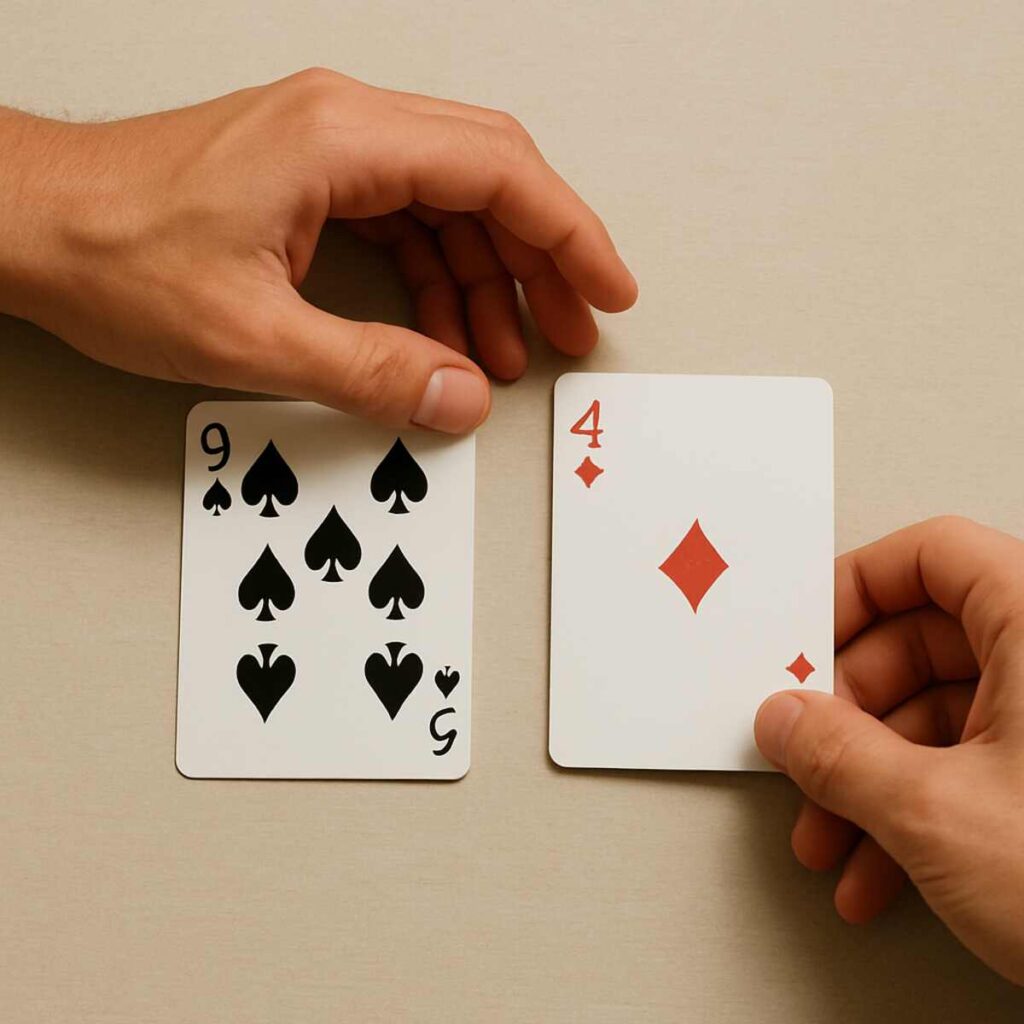
Playing is easy. On the count of three, both players flip their top card over. The player whose card has the higher value wins the round. Just like in the picture, if you flip a 9 and your opponent flips a 4, your 9 wins because it’s greater than 4. You get to collect both cards and add them to the bottom of your own pile.
While it seems basic, this head-to-head comparison is one of the best card games for learning numbers. It turns the “greater than/less than” concept into a fast-paced action instead of a worksheet problem, making it a fun and pressure-free way to build number sense.
But what happens if you both flip a card of the same value? That’s a “war”! Each of you places three more cards face-down, then a fourth card face-up. The player with the higher final card wins all the cards on the table from that round. Keep playing until one person has won the entire deck! Now that you know how to play this math war, you’re ready for a simple twist.
A Simple Twist: How to Play Addition War
If you’ve mastered the simple showdown of “Value War,” you’re ready for a version that makes math practice feel like a game of pure chance. This small change is one of the best ways to get lightning-fast with addition facts without ever touching a flashcard. You already know the basics; this just adds one simple, fun step.
Instead of flipping one card, each player now flips two cards from their pile and places them face-up. The new rule is to add your two card values together. For example, if you flip a 7 and a 3, your total for the round is 10. If your opponent flips a 6 and a 2, their total is 8. Since 10 is greater than 8, you win and collect all four cards.
What makes this one of the most effective and fun math card games for kids (and adults!) is how quickly it builds confidence. After just a few rounds, you’ll stop seeing two separate cards and start seeing their combined value instantly. This automatic recall is the foundation for tackling bigger math problems with ease, and it all happens while you’re just trying to win the round.
Once you’re comfortable with addition, why not try subtraction? For a new challenge, flip your two cards and subtract the smaller number from the larger one. The player with the highest result wins the round. These simple addition and subtraction card games are perfect for a quick five-minute activity, but if you’re looking for a game that lasts a little longer, it’s time to try “Target Number.”
Beat Boredom with “Target Number”
While quick rounds of “War” are great for a fast burst of fun, sometimes you need a game with a little more staying power. “Target Number” is a fantastic race-to-the-finish that turns a simple deck of cards and a piece of scrap paper into an exciting challenge. It’s one of the most flexible addition card games because you decide where the finish line is.
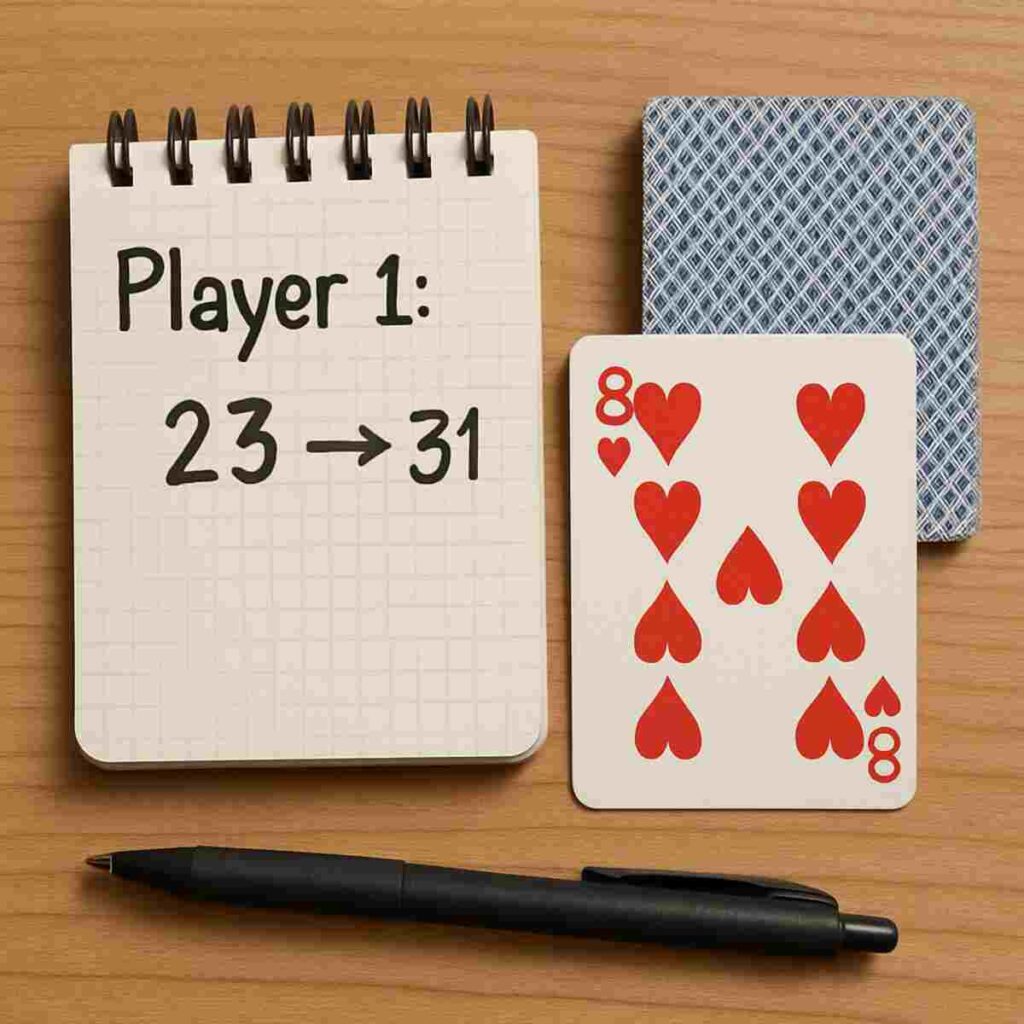
To play, you’ll first need to set the rules. Remove the Jacks, Queens, and Kings, and decide that Aces will count as 1. Next, pick a “target number”—100 is a great place to start. On your turn, you simply flip a card from the deck and add its value to your running score. For example, if your score is 23 and you flip an 8, your new score is 31. The first person to hit or pass 100 wins!
What makes this game so powerful is that it moves beyond single calculations and helps build mental stamina. You aren’t just adding two numbers; you’re constantly updating a total in your head, a skill that’s useful for everything from keeping score in bowling to managing a budget. This simple activity is a perfect example of making math fun by giving it a clear goal and a little friendly competition.
Best of all, this game easily adapts to become one of the best math activities for different age groups. Playing with younger kids? Make the target number 50. Want a new challenge? Try starting at 100 and subtracting each card’s value—the first person to hit zero wins! Once you’ve mastered adding and subtracting your way to a target, you might be ready to bring in a new operation.
How to Make Multiplication Tables Fun Again
If the thought of multiplication tables brings back memories of boring flashcard drills, you’re not alone. But what if you could get that same valuable practice with a game that’s just as fast and exciting as Value War? This is where multiplication practice with a deck of cards really shines, turning a potential chore into a head-to-head challenge.
The setup is identical to Value War: deal the cards evenly, and both players flip one over. Instead of just comparing the numbers, you multiply them together. For instance, if you flip a 7 and your opponent flips a 5, the “product” is 35. If they had flipped a 6 and a 9, their product would be 54. The player with the higher answer wins and collects all the cards from that round.
This simple twist transforms memorization into a rapid-fire competition. The need to be quick and correct to win the round provides instant feedback and a much bigger thrill than any worksheet ever could. The competitive element makes players forget they’re even studying, and the speed of the game builds true fluency, not just slow, deliberate calculation.
Once you’ve mastered the basic numbers, you can add the face cards back in for an extra test. A simple rule is to make Jacks worth 11, Queens 12, and Kings 13, which is perfect for practicing those tougher times tables. This is a great game for pairs, but what if you’re playing alone or want a game that feels more like a puzzle than a race?
A Puzzle for One: The “Make 24” Brain Teaser
For those times you want a quiet challenge instead of a race, some of the best single-player math card games feel more like puzzles. The classic “Make 24” is a perfect example, turning a few random cards into a satisfying brain teaser that you can solve all on your own. The only opponent is the puzzle itself.
The rules couldn’t be simpler. Just lay four cards face-up from the deck. Your goal is to use the number on each card exactly once—along with any combination of addition, subtraction, multiplication, and division—to make the number 24. You can perform the operations in any order you like, and there are often several right answers.
For example, using the cards in the picture (a 6, an 8, a 3, and a 2), here’s one path. You could start by multiplying the 6 and the 3 to get 18. Now you just have to figure out what to do with the remaining 8 and 2. If you add the 8 to your 18, you get 26. From there, just subtract the final card, the 2, and you land perfectly on 24!
What makes this game so powerful is that it moves beyond simple calculation and encourages creative problem-solving. Unlike games with a single correct answer, “Make 24” rewards flexible thinking. You might try one approach that leads to a dead end, only to spot a completely different solution a moment later. It teaches you to look at numbers not just as fixed values, but as flexible tools you can combine in endless ways.
How to Adapt These Games for Any Age Group
One of the best things about using a deck of cards for math is how easily you can change the rules. The goal is to find that sweet spot where the game is challenging enough to be fun but not so hard that it becomes frustrating. By tailoring these math activities, you can keep everyone from a kindergartener to a teenager engaged.
The key is to adjust the complexity to match the player by changing which cards you use or what operations are allowed. Here’s a simple guide to get you started:
- For Ages 4-6 (The Littlest Learners): Focus on the absolute basics. Use only cards 1 (Ace) through 5. Play a simple “Value War” where players flip one card and the person with the bigger number wins. This is a great way to build number recognition and counting skills without any pressure.
- For Ages 6-8 (Building Confidence): Use cards 1 through 10. Now, you can play “Addition War” or “Subtraction War.” This is perfect for practicing facts until they become second nature. You can also introduce “Target Number,” setting the goal at an easy-to-reach 20.
- For Ages 9+ (Ready for a Challenge): Bring in the full deck and all the operations. This is the time for “Multiplication War” and puzzles like “Make 24,” which encourage flexible, strategic thinking.
Want to introduce a concept that even stumps some adults? Try using card colors to represent positive and negative numbers. For example, you could decide that all red cards (Hearts and Diamonds) are negatives and all black cards (Clubs and Spades) are positives. In a game of “Addition War,” if one player flips a red 7 (-7) and the other flips a black 10 (+10), the total is 3. This simple twist adds a whole new layer of strategy.
Ultimately, the benefits of educational card games come from their flexibility. Feel free to invent your own rules! As long as players are laughing and thinking with numbers, you’re doing it right.
Ready for a Challenge? Introducing Fractions with Cards
Once you’ve mastered the basic operations, you can use a deck of cards to tackle a concept that often trips up kids and adults alike: fractions. Don’t worry, this isn’t about finding common denominators. We’re going to play “Fraction War,” a game that makes fractions feel more like a visual puzzle than a math problem and helps build intuition in a low-pressure way.
The setup is a simple twist on classic War. Instead of flipping one card, each player flips two. The first card becomes the top number of the fraction (the numerator), and the second card is the bottom number (the denominator). So, if you flip a 2 and then a 5, your fraction is 2/5. If your opponent flips a 1 and then a 3, their fraction is 1/3.
Deciding the winner is where the real thinking happens. Who has the bigger fraction, 2/5 or 1/3? Instead of reaching for a calculator, try to picture it. Is having two slices of a five-slice pizza more or less than one slice of a three-slice pizza? The player with the larger fraction wins all four cards. This game is great for improving math skills precisely because it encourages you to reason your way to an answer.
Playing this game does something powerful: it turns an abstract idea into a physical object. A fraction isn’t just a number on a page anymore; it’s a relationship between two cards you’re holding in your hand. This gives you a tangible way to see how numbers relate to each other, building a deeper and more confident understanding of math.
You Now Have a Secret Math Lab in Your Pocket
That deck of cards sitting in your drawer now looks a little different, doesn’t it? What was once just for passing the time has transformed into a powerful, portable kit for playful learning. You hold the key to turning a quiet afternoon into an opportunity for connection and confidence-building, all with a simple shuffle and deal.
Whether you’re starting with Value War, racing to add numbers in Addition War, or tackling a brain-teaser like Make 24, you’ve discovered the core secret. These games replace math anxiety with a sense of discovery and fun.
The next step is the easiest one. Don’t try to master them all at once. Just choose one game that caught your eye and give it a try tonight. The goal isn’t perfect calculation; it’s shared laughter and seeing the gears turn.
From this point forward, you’ll never see a deck of cards the same way again. It’s a math-anxiety-buster, a screen-free alternative, and a way to prove that numbers can be a source of joy. The true win isn’t who has the most cards at the end, but hearing excitement and laughter where there might have once been groans. That’s the magic you’ve just unlocked.